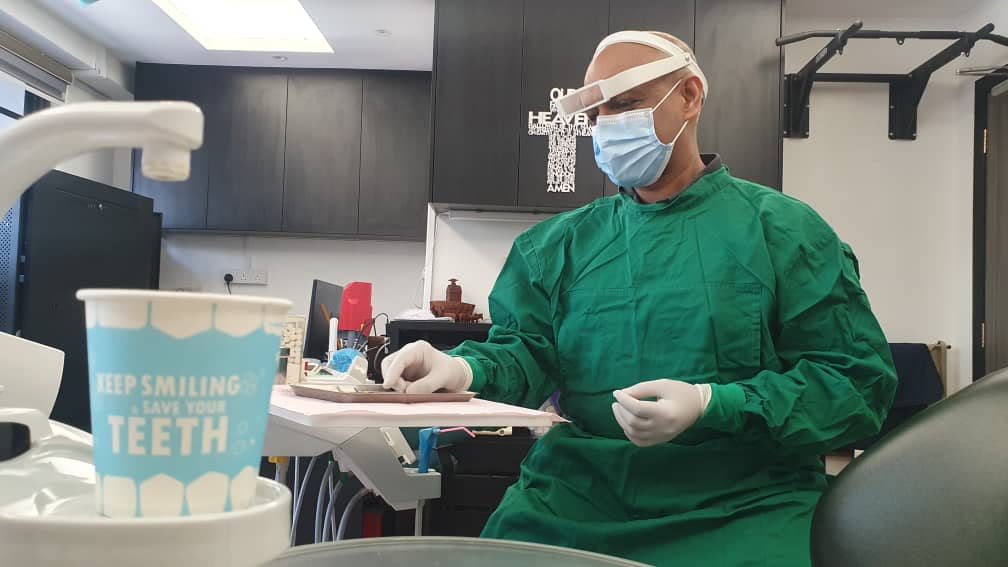
“Teeth are meant to last a lifetime, so please take very good care of them.”
Fifty-year-old dental surgeon, Dr. Thiagan Sinnadurai, shares this well-known but often neglected nugget of wisdom as he leans back in his chair.
Hailing from Port Dickson, he pursued his passion in dentistry in Sydney, Australia before returning home to Malaysia to practice and opening his own private clinic in 1999.
With almost 30 years of dental practice under his belt, Dr. Thiagan focuses on implants and reconstructive dentistry apart from providing the usual dental treatments.
When he’s not at the clinic he would be spending time with his three children, and his other interests including playing musical instruments, travelling, doing charity work, and hiking. He also enjoys gardening though he confesses that he’s still finding his green thumb.
Dental care for seniors
“Do you know that your skin sheds daily? That your hair continues to grow? Even your bones grow (in thickness) throughout your life. But after your teeth are formed, that’s all you’ll ever get until the day you die,” he muses.
Dr. Thiagan takes dental health pretty seriously, especially when it comes to seniors.
“Seniors usually come to see me for two main dental issues: Gum disease and tooth decay. This is quite common for those that grew up in the 50s and 60s, where fluoride in water was only available in certain towns and areas,” he said. “Also, dental awareness was still pretty low during those times, compounding the effect of dental problems which they are facing now.”
Fluoride helps to rebuild and strengthen the tooth’s surface or enamel while helping to stop cavities from forming. However, water fluoridation as a public health measure to help prevent dental caries was only implemented nationwide as a government policy in 1972.
Avoiding dental visits
Yet, despite facing these problems, Dr. Thiagan says, the number of senior patients coming to seek dental treatment is quite low, which he attributes to several factors.
“I notice that seniors are very stoic. Even when a dental problem is causing them difficulties in eating, they would just brush it off as a minor inconvenience until it’s too late,” Dr. Thiagan sighs. “So, their children need to be aware of their parents’ change in eating habits, like eating less, or slower, or requesting softer food. This usually indicates they are facing certain dental issues. Encourage them to go for dental check-ups.”
“The other factor is cost. Treatment for tooth decay costs between RM200 – RM300 while treatment for gum disease could set you back about RM500 – RM1000 depending on the severity. For teeth implants, the cost is much higher at around RM6,000 – RM7,000.
“However, the good news is that most private clinics offer payment in installments. Some even offer interest-free installments to help ease their patient’s financial burden.”
“Alternatively,” Dr. Thiagan adds, “our government clinics also offer very good dental care and with a fraction of the cost, including for implants albeit the long wait time. The main takeaway here is that cost shouldn’t be a barrier for seniors to seek dental help.”
Saliva signal dental health
“There’s another thing that many seniors are unaware of that is causing dental problems for them, and that is dry mouth,” Dr. Thiagan explains.
“Saliva is the immune system for your mouth. It has all the antibodies and enzymes to keep it healthy. As you get older, your saliva quantity and quality changes. Where a senior does not have any dental problems for many years but suddenly develops dental issues like tooth decay, dry mouth is the usual suspect,” he adds.
Dry mouth can be a side effect of certain medication given by their doctors, dehydration due to not drinking enough water, cancer treatment or diabetes. He advises Seniors to be aware of the connection between dry mouth and their dental problems and not to ignore it.
“To handle dry mouth,” Dr. Thiagan says, “you can go for your regular dental check-ups. Dentists have certain treatments that they can apply to your teeth to prevent tooth decay. Your dental hygiene also has to be enhanced like brushing teeth 3-4 times a day compared to just twice a day. Of course, drinking lots of water is a given.”
Keeping healthy habits
According to Dr. Thiagan, maintaining healthy teeth and gums for seniors is simple. He offers three easy habits to cultivate good oral health.
“Firstly, have good dental hygiene. This usually means brushing your teeth regularly and in a proper way. Adding flossing and using mouthwash to your routine is a big plus.
“Next, maintain a healthy body. Your general health has a major impact on your dental health. For example, smoking can damage both our body and oral health. Simple exercises like walking can do wonders for your body. Also, please go for your regular dental check-ups.
“Third is having a balanced and healthy diet. The number one enemy of healthy teeth is sugar. I know seniors tend to develop a sweet tooth as they get older but please cut down on your sugar intake. Patients with diabetes have a higher chance to be afflicted by gum disease.
“One more thing I’d like to add for the seniors,” Dr. Thiagan crooked a finger. “Please don’t use your teeth to open bottle caps, crack hard things like nuts with hard shells or even worse, crab shells. Your tooth is not a tool.”
What a joy to eat
He went on to relate an anecdote of an elderly patient he had that finally had his teeth implants done after many delays.
“Every time he comes in for his dental check-up, he would regale me with how well he eats his food now. He would always say, Doctor, I think of you each time I enjoy my meal. ”
The grin on his face reflects how pleased he is with this compliment.
- – Patrick Chin